Prepared decks
Answers written before the call, in beats, reviewed by you — and what happens when one matches a live question.
A deck is a set of questions you expect, each with an answer written in advance from your own material. When a live question matches one closely enough, MiPrep uses the prepared answer instead of generating one.
That is the difference between a copilot that thinks on its feet and one that also remembers what you decided to say when you were calm.
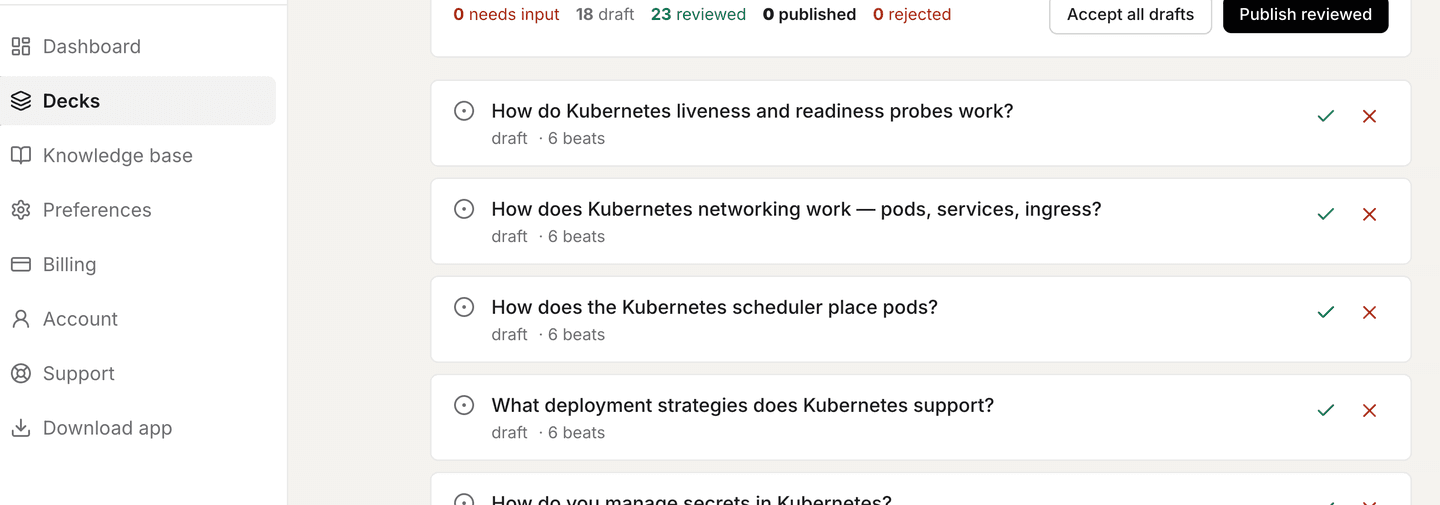
Nothing is published until you say so
Each card moves through states, and the counters at the top of the deck show how many are in each:
| State | Meaning |
|---|---|
| needs input | MiPrep could not write this one from your material. It wants something from you. |
| draft | Written, not yet read by you. |
| reviewed | You accepted it. |
| published | Live — eligible to match during a session. |
| rejected | You threw it out. It will not come back. |
Accept all drafts and Publish reviewed are the bulk moves. The review step is not ceremony: a prepared answer is one you have committed to saying, and the moment to disagree with it is now rather than mid-interview.
A card is beats, not a paragraph
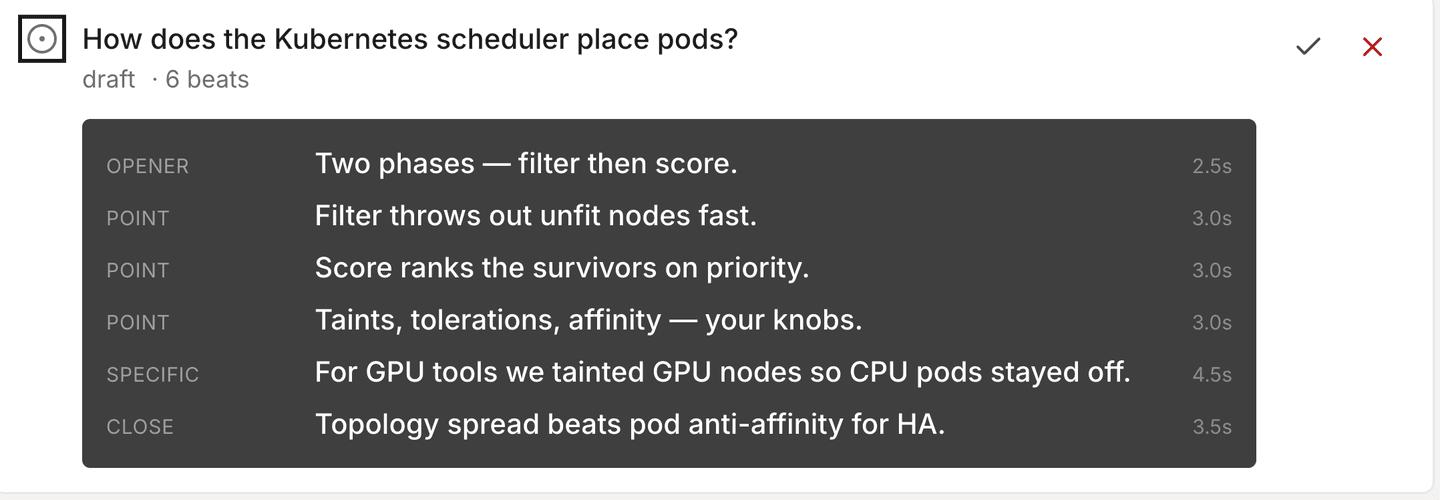
Every card is broken into beats — an opener, a few points, a specific example, a close — and each carries the number of seconds it takes to speak.
That structure is doing two jobs:
- It is readable at a glance. Six short lines can be taken in peripherally. A paragraph cannot, and a paragraph is what makes someone visibly read.
- It has a length you can feel. The per-beat seconds add up to the length of the answer. A 19-second answer and a 90-second answer are different answers to the same question, and the numbers let you decide which one you are giving before you start talking.
The specific-example beat is the one that matters most and the one most likely to need your input — it is where a generic answer becomes yours.
How a card gets matched
During a session, what you and the interviewer say is compared against your published cards. If the wording is close enough, the card is used.
"Close enough" is adjustable — Settings has the strictness dial plus four finer controls, live-tunable mid-practice. Loosen it if obvious matches are missed; tighten it if a card fires on an unrelated question.
If nothing matches, the question is answered normally. A deck adds a fast path; it never becomes the only path.